
- 11 views
Exam
Answer confirmed
Question
Your network contains two Active Directory forests and a domain trust as shown in the following exhibit.
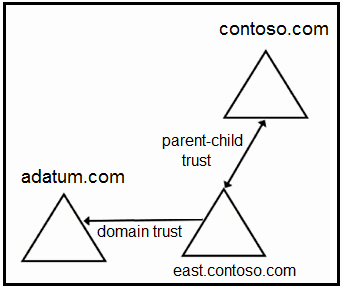
The domain trust has the following configurations:
- Name: adatum.com
- Type: External
- Direction: One-way, outgoing
- Outgoing trust authentication level: Domain-wide authentication
The forests contain the users shown in the following table.
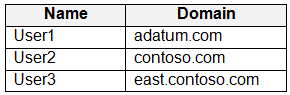
The forests contain the network shares shown in the following table.

For each of the following statements, select Yes if the statement is true. Otherwise, select No.
NOTE: Each correct selection is worth one point.
Proposed answer
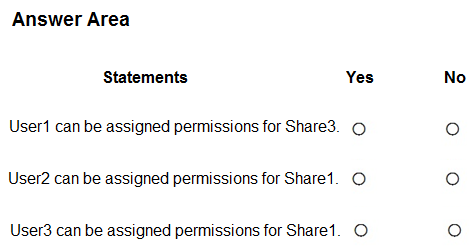
Suggested answer
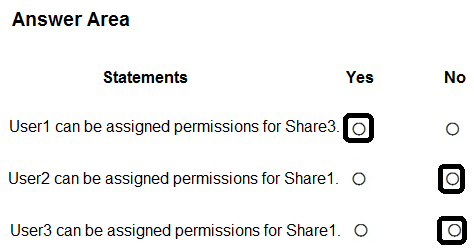
Correct answer
The suggested answer is correct
- Y - User1.adatum.com from trusted domain accessing \\east.contoso.com\Share3 in trusting domain
- N - User2.contoso.com is from untrusted domain accessing \\adatum.com\Share1 in untrusting domain
- N - User3.east.contoso.com trusting domain accessing \\adatum.com\Share1 trusted domain (One way trust, Accessing share in wrong direction)
AlexKL
Highly Voted 1 year, 5 months ago
I think the answer is correct. Since Share3 trusts User1, so User1 can assign permission for Share3. As per Microsoft: "A one-way trust is a unidirectional authentication path created between two domains (trust flows in one direction, and access flows in the other). This means that in a one-way trust between a trusted domain and a trusting domain, users or computers in the trusted domain can access resources in the trusting domain. However, users in the trusting domain cannot access resources in the trusted domain. Some one-way trusts can be either nontransitive or transitive, depending on the type of trust being created."
https://learn.microsoft.com/en-us/previous-versions/windows/it-pro/windows-server-2003/cc759554(v=ws.10)?redirectedfrom=MSDN
upvoted 14 times
skycrap
1 year, 5 months ago
Spot on. I agree.
upvoted 4 times
skycrap
Highly Voted 1 year, 5 months ago
I think that the answer should be: No - No - Yes.
upvoted 10 times
skycrap
1 year, 5 months ago
Change: YES - NO - NO as AlexKL explained.
upvoted 8 times
Shnash
1 year, 3 months ago
Good Boy....
upvoted 4 times
DanielRO
1 year, 3 months ago
You are right. The picture is wrong. The connection is One-way, outgoing. Outgoing not Incoming.
upvoted 2 times
Ksk08
Most Recent 3 weeks, 6 days ago
Answer: No No YES
upvoted 1 times
sardonique
4 months ago
Direction of access is the opposite of direction of trust. so if east.contoso.com one way trusts Adatum.com, that means that adatum users can access east.contoso.com resources, however not the other way around since it is a 1 way trust. There is an implicit trust between all domains within the same forests, so east.contoso and contoso trust each other, thus giving users of both domains the techinical ability to access their respective resources.
upvoted 1 times
zimek1908
4 months, 3 weeks ago
description and picture doesnt match this is why people are arguing.
upvoted 1 times
DE5
6 months ago
To make this a little bit more clear. First the Alex hase absolutley right, the arror on the diagram is represent who trust who, not who connect to, show the east.contoso.com trust the adatum.com and that means the users from adatum.com can have access at resourses o the east.
upvoted 3 times
MichalGr
7 months, 1 week ago
Add on the exhibit u1/s1 @adatum.com - u2/s2 @contoso.com - u3/s3 @east.contoso.com and keep in mind that users in the trusted domain can access resources in the trusting domain, but not the other way around.
upvoted 1 times
Bolo92
11 months, 3 weeks ago
valid 27.11.23
upvoted 1 times
MAKH83
12 months ago
If we take this as a trust relation between 2 neighbours, then: An outgoing trust means that you give your key to your neighbor, so they can enter your home and use your resources. You are the trusting domain, and your neighbor is the trusted domain. You trust them to access your home, but you cannot access theirs. Taking this example, Adatum.com is the trusting domain and east.contoso.com is the trusted domain. As east.contoso.com is trusted, it can access resources in adatum.com but not the other way around.
upvoted 2 times
MAKH83
12 months ago
Had another look at this and actually i agree its No-No-Yes.
upvoted 1 times
MAKH83
12 months ago
So Answer should be No, No, Yes
upvoted 1 times
MR_Eliot
1 year, 2 months ago
Correct Answers:
upvoted 7 times
MR_Eliot
1 year, 1 month ago
upvoted 3 times
Tiago_MP
1 year, 3 months ago
Yes No No That is based on the description, not in the pic, see: https://www.tech-faq.com/understanding-trust-relationships.html
upvoted 2 times