
AZ-800 / Q49 / MS
You have a server that runs Windows Server and has the following volumes:
- Volume E: Contains user home folders
- Volume F: Contains Microsoft SQL Server database
- Volume G: Contains Hyper-V VHD files
- Volume H: Contains Data Protection Manager (DPM) backup files
- Volume I: Hosts shared folders that contain documents
You need to implement Data Deduplication. The solution must optimize storage utilization on the volumes.
On which three volumes should you enable Data Deduplication? Each answer is a complete solution.
AZ-800 / Q48 / MS
Your on-premises network contains an Active Directory Domain Services (AD DS) domain. The domain contains 20 servers that run Windows Server and host shared folders.
You need to optimize the storage on the servers. The solution must meet the following requirements:
- Minimize the storage required for multiple copies of the same data.
- Minimize administrative effort.
What should you do first?
AZ-800 / Q1 / T13
You need to meet the technical requirements for VM3.
On which volumes can you enable Data Deduplication?
AZ-800 / Q6 / T6
Your network contains an Active Directory Domain Services (AD DS) domain named contoso.com. The domain contains two servers named Server1 and Server2.
Server1 contains a disk named Disk2. Disk2 contains a folder named UserData. UserData is shared to the Domain Users group. Disk2 is configured for deduplication. Server1 is protected by using Azure Backup.
Server1 fails.
You connect Disk2 to Server2.
You need to ensure that you can access all the files on Disk2 as quickly as possible.
What should you do?
AZ-800 / Q48 / T5
You have a server named Server1 that runs Windows Server 2022.
You add two 4-TB hard drives named Disk1 and Disk2 to Server1.
You need to format the drives. The solution must meet the following requirements:
• Disk1 must support disk level quotas.
• Disk2 must support Data Deduplication.
Which type of file system should you use for each drive? To answer, select the appropriate options in the answer area.
NOTE: Each correct selection is worth one point.
AZ-800 / Q40 / T5
You need to recover the files on Disk1.
Which files can you recover if you attach Disk1 to Server1, and which files can you recover if you attach Disk1 to Server2? To answer, select the appropriate options in the answer area.
NOTE: Each correct selection is worth one point.
AZ-800 / Q31 / T5
You have a server named Server1 that runs Windows Server and contains three volumes named C, D, and E.
Files are stored on Server1 as shown in the following table.
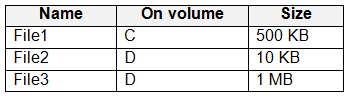
For volume D, Data Deduplication is enabled and set to General purpose file server.
You perform the following actions:
AZ-800 / Q30 / T5
You have a server named Server1 that runs Windows Server and contains two drives named C and D. Server1 hosts multiple file shares.
You enable Data Deduplication on drive D and select the General purpose file server workload.
You need to minimize the space consumed by files that were recently modified or deleted.
What should you do?
AZ-800 / Q6 / T5
Your network contains an Active Directory Domain Services (AD DS) domain named contoso.com. The domain contains two servers named Server1 and Server2.
Server1 contains a disk named Disk2. Disk2 contains a folder named UserData. UserData is shared to the Domain Users group. Disk2 is configured for deduplication. Server1 is protected by using Azure Backup.
Server1 fails.
You connect Disk2 to Server2.
You need to ensure that you can access all the files on Disk2 as quickly as possible.
What should you do?