
DNS forwarding rulesets
DNS forwarding rulesets enable you to specify one or more custom DNS servers to answer queries for specific DNS namespaces. The individual rules in a ruleset determine how these DNS names are resolved. Rulesets can also be linked one or more virtual networks, enabling resources in the VNets to use the forwarding rules that you configure.
A ruleset can't be linked to a virtual network in another region.
AZ-800 / MS
- Read more about AZ-800 / MS
- 2 views
Your on-premises network contains an Active Directory Domain Services (AD DS) domain.
The domain contains 100 Windows client devices that are joined to the domain.
You have an Azure subscription that contains a virtual network named Vnet1 and 10 virtual machines that run Windows Server. The virtual machines are configured as a workgroup and are connected to Vnet1. Vnet1 contains a virtual network gateway that connects to the on-premises network.
AZ-800 / MS
- Read more about AZ-800 / MS
- 3 views
Your on-premises network hosts a DNS zone contoso.com on internal DNS servers.
You need to identify the name of the primary DNS server for the contoso.com zone.
Which type of DNS record should you query?
Select only one answer.
AZ-800 / Q34 / MS
You have a web server named web1.contoso.com that is configured with a static IP address of 10.10.1.25.
You run the nslookup web1.contoso.com command and receive the following message.
C:\users\administrator>Nslookup web1.contoso.com
Default Server: dc1.contoso.com
Address: 10.10.1.5
*** dc1.contoso.com can’t find web1.contoso.com: Non-existent domain
You need to ensure that web1.contoso.com can be resolved.
Which type of record should you create?
AZ-800 / Q33 / MS
You have an Azure subscription that contains two virtual networks named VNet1 and VNet2. VNet1 is in the US East Azure region. VNet2 is in the North Europe Azure region.
You create a private DNS zone named Contoso.local and link it to VNet1.
You need to ensure that devices connected to VNet2 can resolve records in Contoso.local. The solution must minimize administrative effort.
What should you do?
AZ-800 / Q1 / T11
You need to implement a name resolution solution that meets the networking requirements.
Which two actions should you perform? Each correct answer presents part of the solution.
NOTE: Each correct selection is worth one point.
AZ-800 / Q25 / T5
Your network contains an Active Directory Domain Services (AD DS) forest. The forest contains three domains. Each domain contains 10 domain controllers.
You plan to store a DNS zone in a custom Active Directory partition.
You need to create the Active Directory partition for the zone. The partition must replicate to only four of the domain controllers.
What should you use?
AZ-800 / Q23 / T5
You have an on-premises DNS server named Server1 that runs Windows Server. Server1 hosts a DNS zone named fabnkam.com.
You have an Azure subscription that contains the resources shown in the following table.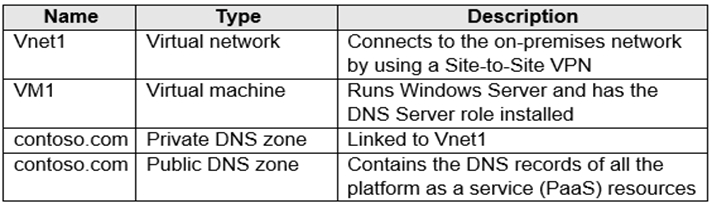
You need to design a solution that will automatically resolve the names of any PaaS resources for which you configure private endpoints in Vnet1.
AZ-800 / Q14 / T5
Your network contains an Active Directory Domain Services (AD DS) forest. The forest contains three domains. Each domain contains 10 domain controllers.
You plan to store a DNS zone in a custom Active Directory partition.
You need to create the Active Directory partition for the zone. The partition must replicate to only four of the domain controllers.
What should you use?
AZ-800 / Q34 / T4
Your network contains an Active Directory Domain Services (AD DS) forest. The forest contains the servers shown in the following table.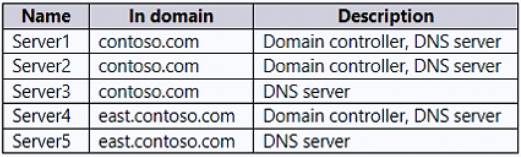
On Server1, you create a DNS zone named Zone1.com as shown in the following exhibit.