
AZ 801 / Q5 / T4
Your network contains an Active Directory Domain Services (AD DS) domain. The domain contains the servers shown in the following table.
Server3 contains a share named Share1.
On Server1, DHCP has the following configurations:
✑ Conflict detection attempts: 3
✑ An IPv4 scope named Scope1 that has the following settings:
1. Address Pool: 172.16.10.100 - 172.16.10.130
2. Address Leases:
AZ 801 / Q4 / T4
You have two file servers named Server1 and Server2 that run Windows Server. Server1 contains a shared folder named Data. Data contains 10 TB of data.
You plan to decommission Server1.
You need to migrate the files from Data to a new shared folder on Server2. The solution must meet the following requirements:
✑ Ensure that share, file, and folder permissions are copied.
✑ After the initial copy occurs, ensure that changes in \\Server1\Data can be synced to the destination without initiating a full copy.
✑ Minimize administrative effort.
What should you use?
AZ 801 / Q3 / T4
You have an on-premises server that runs Windows Server and has the Web Server (IIS) server role installed. The server hosts a web app that connects to an on- premises Microsoft SQL Server database.
You plan to migrate the web app to an Azure App Services web app. The database will remain on-premises.
You need to ensure that the migrated web app can access the database.
What should you configure in Azure?
AZ 801 / Q2 / T4
Your network contains an Active Directory Domain Services (AD DS) domain named contoso.com. The functional level of the forest and the domain is Windows
Server 2012 R2. The domain contains the domain controllers shown in the following table.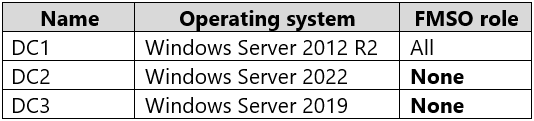
You need to raise the forest functional level to Windows Server 2016. The solution must meet the following requirements:
AZ 801 / Q1 / T4
You manage 200 physical servers that run Windows Server.
You plan to migrate the servers to Azure.
You need to prepare for discovery of the servers by using Azure Migrate.
Which three actions should you perform in sequence on a physical server? To answer, move the appropriate actions from the list of actions to the answer area and arrange them in the correct order.
AZ 801 / Q22 / T3
You have an Azure subscription that contains a user named User1 and the resources shown in the following table.
User1 has a computer named Computer1 that runs Windows 11. User1 works from home and establishes a Point-to-Site (P2S) connection to GW1 to access AppSvr1.
You deploy the resources shown in the following table.
AZ 801 / Q21 / T3
You have two servers named Host1 and Host2 that run Windows Server and are members of a workgroup named Contoso. Both servers have the Hyper-V server role installed and are identical in hardware and configuration.
Host1 contains three virtual machines. Each server is located in a separate site that connect by using a high-speed WAN link.
You need to replicate the virtual machines from Host1 to Host2 for a disaster recovery solution.
Which three actions should you perform? Each correct answer presents part of the solution.
AZ 801 / Q20 / T3
You have an Azure virtual machine named VM1 that runs Windows Server.
The operating system on VM1 fails to start due to a disk error.
You need to resolve the error.
Which four commands should you run in sequence in Azure Cloud Shell? To answer, move the appropriate commands from the list of commands to the answer area and arrange them in the correct order.
AZ 801 / Q19 / T3
You have an on-premises server named Server1 that runs Windows Server.
You have an Azure subscription.
You plan to back up the files and folders on Server1 by using the Microsoft Azure Recovery Services (MARS) agent.
You need to identify to which location the backups can be written and the maximum number of scheduled backups that can be performed per day.
What should you identify? To answer, select the appropriate options in the answer area.
NOTE: Each correct selection is worth one point.
AZ 801 / Q18 / T3
Your network contains an on-premises Active Directory Domain Services (AD DS) domain. The domain contains two virtual machines named VM1 and VM2 that run Windows Server.
You plan to implement a failover cluster named Cluster1 that will use VM1 and VM2 as nodes.
You need to ensure that Cluster1 can use floating IP addresses.
Which two components should you deploy? Each correct answer presents part of the solution.
NOTE: Each correct selection is worth one point.