- 4 перегляди
Overview -
Company Information -
ADatum Corporation is a manufacturing company that has a main office in Seattle and two branch offices in Los Angeles and Montreal.
Fabrikam Partnership -
ADatum recently partnered with 2 company named Fabrikam, Inc.
Fabrikam is a manufacturing company that has a main office in Boston and a branch office in Orlando.
Both companies intend to collaborate on several joint projects.
Existing Environment -
ADatum AD DS Environment -
The on-premises network of ADatum contains an Active Directory Domain Services (AD DS) forest named adatum.com.
The forest contains two domains named adatum.com and east.adatum.com and the domain controllers shown in the following table.
Fabrikam AD DS Environment -
The on-premises network of Fabrikam contains an AD DS forest named fabrikam.com.
The forest contains two domains named fabrikam.com and south.fabrikam.com.
The fabrikam.com domain contains an organizational unit (OU) named Marketing.
Server Infrastructure -
The adatum.com domain contains the servers shown in the following table.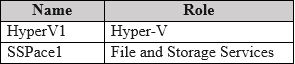
HyperV1 contains the virtual machines shown in the following table.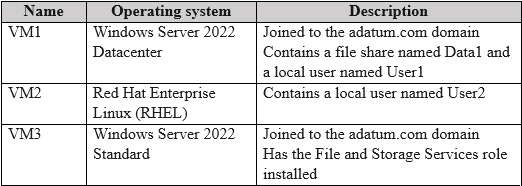
All the virtual machines on HyperV1 have only the default management tools installed.
SSPace1 contains the Storage Spaces virtual disks shown in the following table.
Azure Resources -
ADatum has an Azure subscription that contains an Azure AD tenant. Azure AD Connect is configured to sync the adatum.com forest with Azure AD.
The subscription contains the virtual networks shown in the following table.
The subscription contains the Azure Private DNS zones shown in the following table.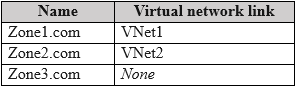
The subscription contains the virtual machines shown in the following table.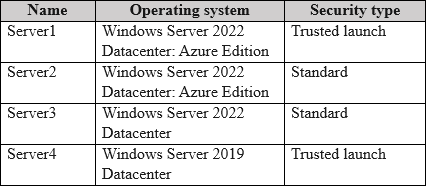
All the servers are in a workgroup.
The subscription contains a storage account named storage1 that has a file share named share1.
Requirements -
Planned Changes -
ADatum plans to implement the following changes:
• Sync Data1 to share1.
• Configure an Azure runbook named Task1.
• Enable Azure AD users to sign in to Server1.
• Create an Azure DNS Private Resolver that has the following configurations:
• Name: Private1
• Region: West US
• Virtual network: VNet1
• Inbound endpoint: SubnetB
• Enable users in the adatum.com domain to access the resources in the south.fabrikam.com domain.
Technical Requirements -
ADatum identifies the following technical requirements:
• The data on SSPace1 must be available always.
• DC2 must become the schema master if DC1 fails.
• VM3 must be configured to enable per-folder quotas.
• Trusts must allow access to only the required resources.
• The users in the Marketing OU must have access to storage1.
• Azure Automanage must be used on all supported Azure virtual machines.
• A direct SSH session must be used to manage all the supported virtual machines on HyperV1.
Which two languages can you use for Task1? Each correct answer presents a complete solution.
- A. Bicep
- B. Python
- C. Java
- D. PowerShell
- E. JavaScript
BD (100%)
The suggested answer is correct
- B. Python
- D. PowerShell
Shared resources
Azure Automation consists of a set of shared resources that make it easier to automate and configure your environments at scale.
- Schedules - Trigger Automation operations at predefined times.
- Modules - Manage Azure and other systems. You can import modules into the Automation account for Microsoft, third-party, community, and custom-defined cmdlets and DSC resources.
- Modules gallery - Supports native integration with the PowerShell Gallery to let you view runbooks and import them into the Automation account. The gallery allows you to quickly get started integrating and authoring your processes from PowerShell gallery and Microsoft Script Center.
- Python 2 and 3 packages - Support Python 2 and 3 runbooks for your Automation account.
- Credentials - Securely store sensitive information that runbooks and configurations can use at runtime.
- Connections - Store name-value pairs of common information for connections to systems. The module author defines connections in runbooks and configurations for use at runtime.
- Certificates - Define information to be used in authentication and securing of deployed resources when accessed by runbooks or DSC configurations at runtime.
- Variables - Hold content that can be used across runbooks and configurations. You can change variable values without having to modify any of the runbooks or configurations that reference them.
SIAMIANJI
6 months, 2 weeks ago
Selected Answer: BD
For configuring an Azure runbook in Azure Automation, you can use two primary scripting languages: PowerShell: PowerShell is the most commonly used language for creating Azure Automation runbooks. It provides a robust scripting environment with rich capabilities for automating tasks in Azure and other Microsoft environments. PowerShell scripts can interact with Azure resources using Azure cmdlets and APIs. Python: Azure Automation also supports Python as a scripting language for creating runbooks. Python is a popular and versatile language known for its simplicity and readability. With Python scripts, you can automate various tasks in Azure, just like you would with PowerShell.
upvoted 3 times
windowsmodulesinstallerworker
1 year, 1 month ago
Selected Answer: BD
https://learn.microsoft.com/en-us/azure/automation/automation-runbook-types